



Please call us or fill in the form below and we will be delighted to help with your enquiry.
 0207 386 0464
Forehead Cyst Removal with Minimal Scarring Techniques
Forehead cyst removal is a safe and precise procedure to eliminate unwanted cysts on the forehead while minimising scarring. Using pain-free laser and surgical techniques, our experienced clinicians ensure effective removal tailored to the sensitive area. Each cyst is carefully assessed for suitability, and, where necessary, samples can be sent for analysis to guarantee safety. This minimally invasive treatment provides a quick solution, restoring smooth, clear skin and improving both appearance and confidence.
Treatment Benefits

Time

Recovery

Results

Duration



Forehead Cyst Treatment Information
What is a cyst on the forehead?
Skin cysts can generally appear anywhere on the face or body, including the forehead. Although these white or yellow round lumps are non-cancerous, they can cause considerable concern for patients because they’re particularly noticeable. Makeup cannot conceal them because they’re raised. There’s little that can be done to hide forehead cysts if they can’t be covered by hair.
How are cysts formed on the forehead?
One of the most common reasons why people get cysts is because hair follicles are blocked; so cysts may occur wherever there’s hair on the body, including the back and genitals.
Although the forehead may appear to be ‘hair free’, there are still pores and follicles. Cysts can also appear due to damage or injury. Sometimes you may get a cyst and never really know why it started. Forehead cysts contain keratin (protein) and dead skin cells and keratin (protein). They can swell up under the skin. It’s common and it happens frequently.
How to get rid of the cyst on your forehead
The safest and most effective way to get rid of a forehead cyst is by having it removed by an experienced doctor or surgeon in a minor surgical procedure. It’s very important to ensure that the entire cyst sac is removed, otherwise the cyst is likely to regrow. That’s why surgery is the best option. Your doctor/surgeon will not only drain the cyst of all the ‘gunk’ or goo inside it. They’ll also extract the sac in its entirety. This is pain-free as local anaesthetic is used.
How do I know if it is a cyst or a lipoma?
What distinguishes lipoma from a cyst? Ideally, it’s best to see a doctor for a proper diagnosis. Although they look similar, there are differences. Cysts, like lipoma, develop slowly beneath the skin, but with the slightest pressure, the lump slides effortlessly. In contrast to lipoma, the sacs in a cyst contain keratin, a vital skin protein with an oily, cheese-like feel, rather than a clump of fat cells. Lipoma don’t tend to move around as much within the skin.
What types of cysts are formed on the forehead?
Epidermoid cysts
An epidermoid cyst is a cyst where the cyst sac forms from cells that normally occur on the top layer of the skin (the epidermis). Epidermoid cysts have the appearance of a tiny to a medium-sized clot and range in size from millimeters to inches in width. The underlying skin might be flesh-colored, white, or yellowish and filled with cheesy-looking white keratin debris.
Sebaceous cyst
Sebaceous cysts don’t hurt, so it’s possible to dismiss them as small harmless lumps that grow beneath the skin. However, if the area is painful, red, and swollen, then it’s likely the cyst is infected. If your cyst bursts, you will generally feel relief. You may notice a foul smell accompanied by a grayish-white, cheesy fluid that drains from it. Unfortunately, unless the cyst sac is properly removed, the cyst is likely to reform over time.
If you have a cyst on your body, but more in particular, your forehead, it’s best to see a professional for a proper assessment and diagnosis. At Cosmedics Skin Clinics, our doctors and surgeons can treat the most cysts same day in the clinic.
What is the most common type of cyst on the forehead?
Epidermoid Cyst
Epidermoid cysts (keratin, sebaceous, or epithelial cysts) are tiny, solid lumps that form beneath the skin.
Pilar Cyst
Pilar cysts are most frequent on the scalp and develop when a hair follicle becomes blocked.
Acne Cyst
People with acne may develop cystic acne. This acne could result in painful, pus-filled lesions formed far beneath the skin’s surface.
At what size does a forehead cyst need surgery?
However big or small lit is, if your cyst is bothering you, then you can look at getting it removed privately. Ideally, it’s better to remove cysts before they become bigger. It stands to reason that smaller cysts will leave smaller scars. In addition, removing cysts earlier avoids the potential risk of them becoming inflamed or infected, which can make them much bigger.
What can happen if a forehead cyst is left untreated?
Left alone, cysts tend to get bigger over time, becoming more noticeable and obvious. Larger cysts are also more likely to catch on clothing. Not all cysts get infected, but that is a possibility and the longer you have it, the more likely that will become. Infection can spread to the surrounding skin and have significant consequences.
Why choose Cosmedics for forehead cyst removal
Cosmedics Skin Clinics specialises in the removal of difficult skin lesions and blemishes. It offers removal of cysts of all sizes in its London and Bristol clinics. All treatments are carried out by doctors and surgeons who have extensive experience in carrying out these procedures which are made entirely pain-free thanks to local anaesthetic. The company works hard to deliver minimal scarring results through its advanced techniques.
By making clinical treatments affordable in a welcoming and professional environment, Cosmedics has become a leading destination for skin treatments. They offer long appointments so their doctors will often be able to remove the cyst during the same appointment.
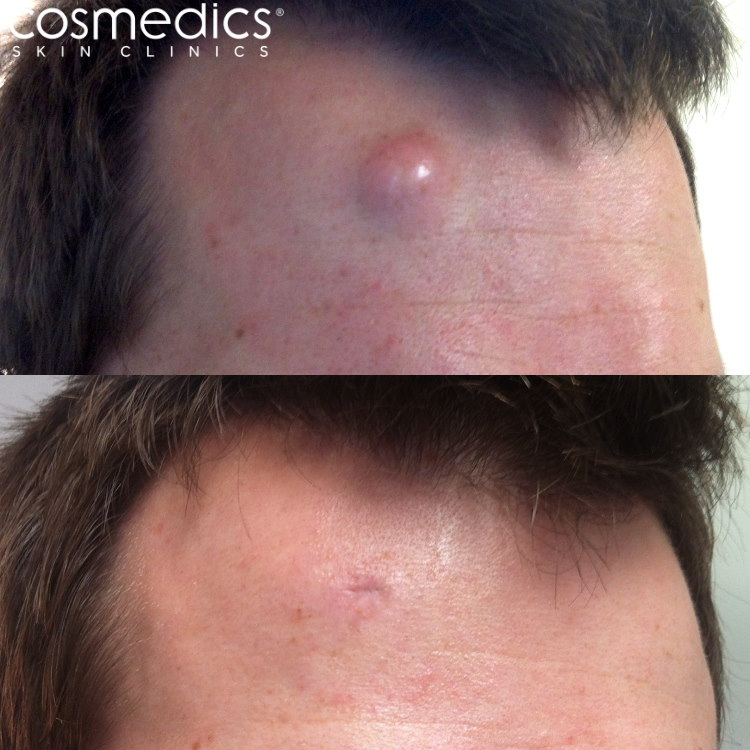
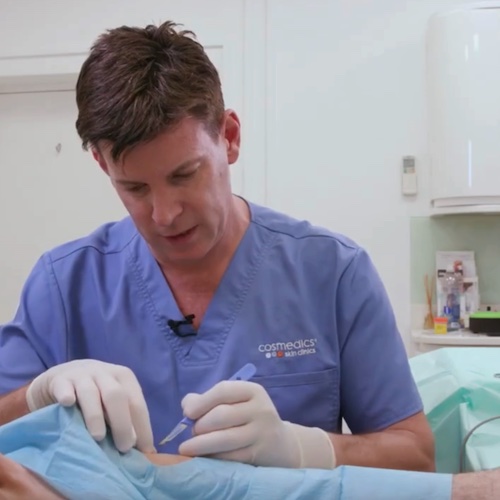
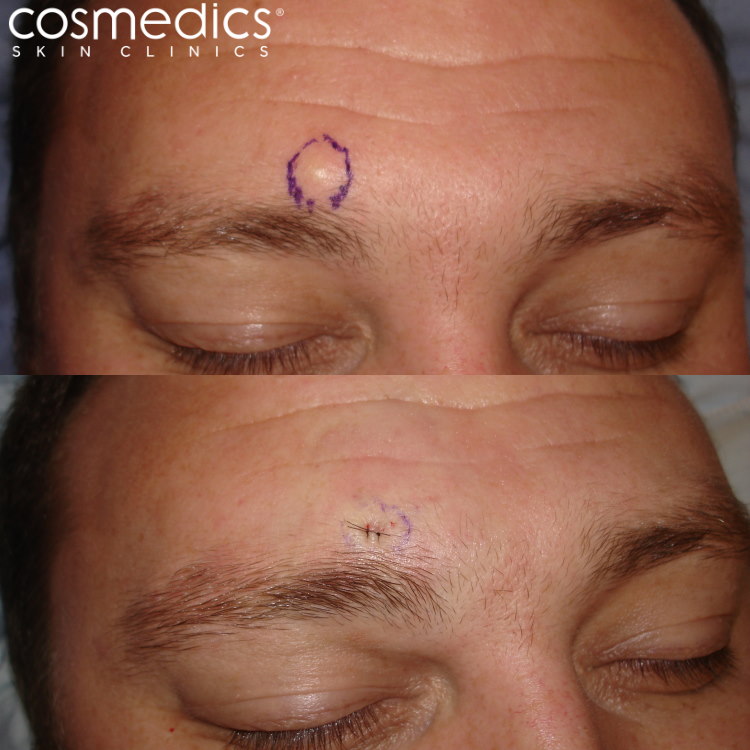
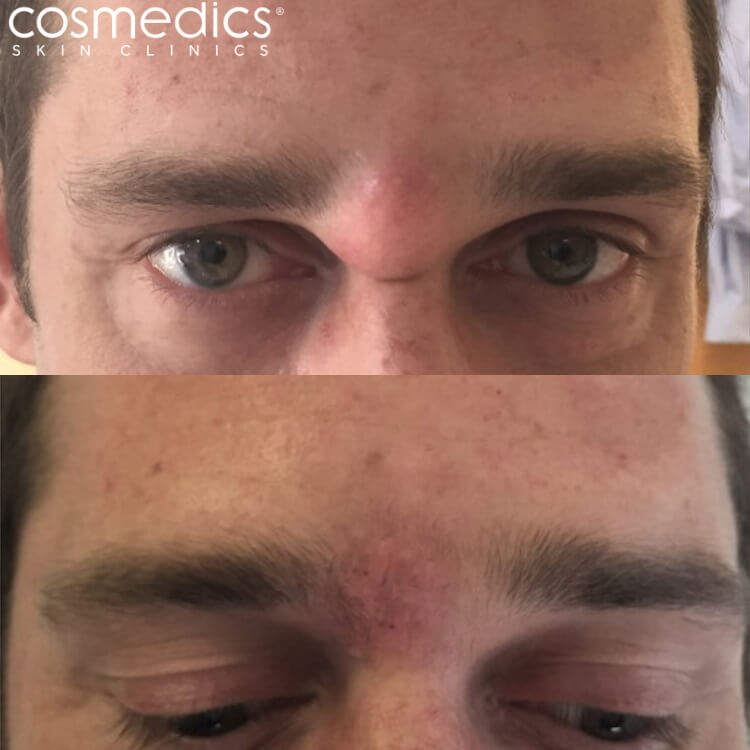
Forehead Cyst Removal Results Photos & Video




FAQ's
Forehead Cyst Removal Questions & Answers

Yes, often. While many are standard sebaceous cysts, the forehead is a common site for Dermoid Cysts or Lipomas (fatty lumps) that sit close to the bone. Because the skin on the forehead is thin and sits directly over the frontal bone, a specialist assessment is vital to determine exactly how deep the lump sits before removal.
If the cyst is “flaring up,” red, or painful, it may be infected. We may recommend a “cool down” period or a course of antibiotics before surgical removal. Removing a cyst while it is calm allows for a smaller incision and a much better cosmetic scar. Our doctors are highly experienced and will give appropriate advice once they’ve assessed the cyst at consultation.
Where possible, we aim to place the incision within the horizontal natural creases of your forehead. Once healed, the scar mimics a natural forehead line. Where this is not possible, we still seek optimum results through precise techniques designed to minimise scarring. Results after forehead cyst removal are significantly less noticeable than the original lump.
During the local anaesthetic injection, you may feel a brief sensation of pressure because the skin is tighter against the skull than on the cheek or neck. However, the numbing agent works very quickly, and you will not feel any pain during the actual removal.
We recommend avoiding tight hats, beanies, or helmets (like cycling or motorcycle helmets) for at least 7 days. Pressure and friction on the fresh incision can cause the stitches to pull or lead to irritation. Once the stitches are removed, you can resume wearing headwear.
Because the forehead is a vascular area, minor swelling is common. In some cases, gravity can cause this swelling or slight bruising to settle around the bridge of the nose or upper eyelids over the first 48 hours. This is temporary and usually subsides within a few days. Keeping your head elevated and using a cold compress can help.
When a large or long-standing cyst is removed, there may be a slight temporary indentation where the tissue was stretched. However, the skin and underlying tissue are remarkably resilient; in most cases, the area levels out and heals flush with the surrounding skin within a few weeks.